Words, Worms, Patch-Work: Landscaping in Fabric
or Editing with Earth? With Emma Fukuwatari Huffman at Bubble Box Studio.

A little while ago I joined the workshop ‘Landscaping in Fabric’, hosted by Emma Fukuwatari Huffman at Bubble Box Studio, a space for collective artistic research practice in Amsterdam.
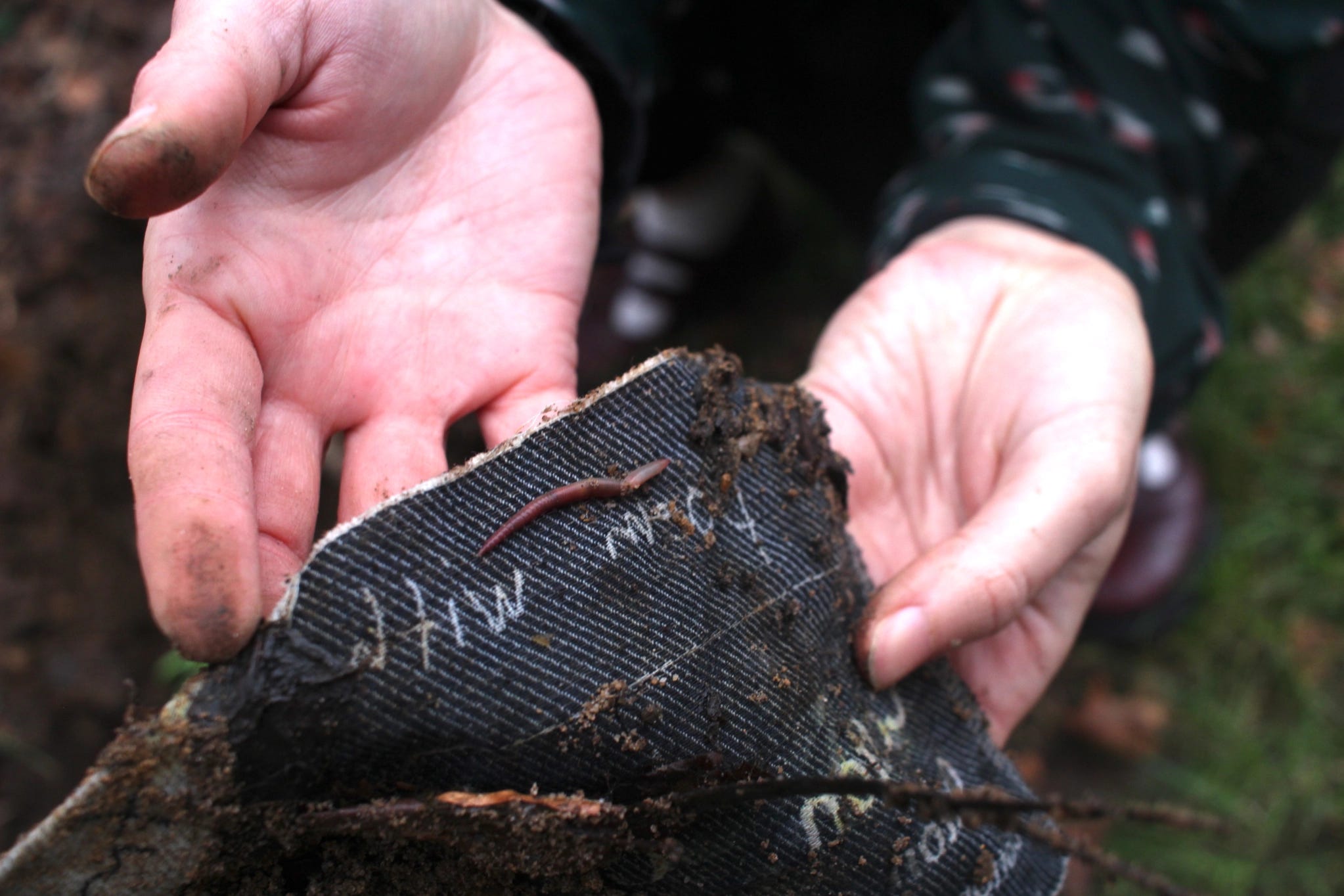
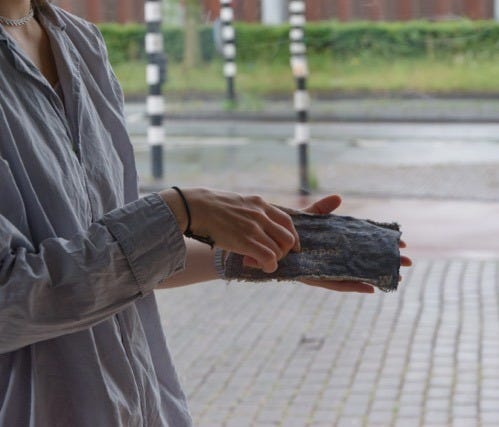
Emma had buried small patches of fabric in the soils of Arnhem and Kyoto and dug them up again months later. Our task that day was to alter these changed patches further: to pay needling attention, add to, embellish, underline or undo the changes brought forth by their time spent underground.
Before we began, Emma showed us an image of a dark dress spotted noticeably with holes. She asked for our immediate associations: ‘Moths’, was the consensus. Moths, exactly!, animals we unwittingly and unhappiliy share our closets with. A long while ago, Emma had started to wonder what our clothes signify to these animals, in turn: Food, or food for their babies? What is it that attracts them to particular folds and fabrics? Moths alter our garments uninvited, and in response we mend them, and this is a sort of collaboration. ‘Landscaping in fabric’ is a similar process, but less incidental and begrudging. Here, the patches were buried intentionally, inviting, even hoping for, a response — first from the earth and its inhabitants, then from us (the workshop participants/co-researchers). The practice ventures a curious, probing step beyond the preconceptions of damaging and fixing.
A previous working title for this co-creative exercise had been ‘A poem with Earth: Editing with more-than-human beings’, Emma mentioned. She’d let go of it because of the implications in the word ‘editing’ of correcting, polishing and perfecting. Still, I think the concept of editing has something to gain from this practice, if not the other way around. If this is editing, what else can editing become? The same goes for ‘landscaping’, which has its own underbelly of associations. What I want to do here is roll both of these words around in the metaphorical snow of Emma’s project like a snowman’s head, so that they acquire a fresh outermost layer of meaning.
Landscaping in Fabric
What do you think of when you think ‘landscape’? What comes up first, a definition? Or a picture? For me, it’s in the first instance a deeply ingrained image: green fields, largely empty, criss-crossed by water and dotted with cows under a grey sky textured with clouds that have somewhere to go. Then, it’s attempts at a definition without consulting Merriam-Webster: Is ‘landscape’ what an ecosystem looks like to us on the surface? Is it the visual characteristics of a certain area of land?
English ‘landscape’ comes from Dutch ‘landschap’, which meant ‘a stretch of land’. In English, though, a landscape was first a painting: framed hills, trees, clouds and light, a notable absence or de-centering of human figures. Often times painted from memory, with painstakingly close attention to detail. It captured the outside in as much detail as possible to hang it on an inside wall.
‘Landscaping’, the verb — landscape gardening, and a little later landscape architecture, describes something quite different. It’s the rearrangement of an actual area of land and its vegetation to suit human sensibilities, fashions, signalling of status or other more specific purposes. The land itself becomes the blank canvas, and landscape gardeners and architects act as more or less disruptive sculptors. The prototypical landscape in my mind’s eye, for example, was sculpted intensively for the purposes of industrial-scale dairy production.
European landscaping, the large-scale ‘improvement’ and ‘beautification’ of land, has a history of both social and ecological violence. It put into practice the conceptual triumph of ‘reason’ over ‘wilderness’, led to the displacement and dispossession of rural populations, and was substantially funded by slave labour on colonial plantations. 1
But landscaping can also be regenerative, and maybe even collaborative and playful when it’s not a rearrangement, but a storying of soil. This requires something of the attentive devotion of the Renaissance painter, but less aesthetic ambition and more open curiosity. Landscape stories are possible answers to Anna Tsing question: “Can I show landscape as the protagonist of an adventure in which humans are only one kind of participant?” And the moth is another, and the worms are another? What if landscaping meant telling stories together with the land? ‘Landscaping in Fabric’ is an art practice that tells such a collaborative story. The landscape itself imprints itself on the fabric, and we annotate. As a result, the landscape loses its surface quality, comes alive, eats and digests your canvas. Not metaphorically: some of Emma’s patches in Kyoto disappeared completely during the months they spent underground, so there was nothing to unearth.
There’s a certain cross-rhyming poetry to working with patches of fabric and patches of soil, doing patch-work. It implies a practice that is local, somewhat unpredictable and extremely adaptive. Anna Tsing writes: “Landscapes and landscape knowledge develop in patches.” Like patches of mushrooms spring up after a day and a night of rain. “Patches spread, mutate, merge, reject each other, and die back. The hard work— and the creative, productive play—of science, as well as emerging ecologies, happens in patches.”
Editing with earth
An edit is in the first instance — the first instance being Latin — something that is ‘brought forth’. A very passive notion that perhaps fits into the image we have of what the earth does. To quote none other than the Bible, “the earth bringeth forth fruit of herself: first the blade, then the ear, after that the full grain in the ear” (Mark 4:28).
Editing is also something that is done to a text before it is submitted, and then again before it is published. This is to get rid of factual errors, typos, sentences that miss a verb. It can be to make a text more concise, more convincing, more congruent with a certain formula, less offensive, or to make it sing, make it jump at you. Editing is a tedious and rewarding process, maybe even more rewarding than writing. And editing with earth, I think, is less like preparing for publication on a tight schedule and more like ruminating over the right words to describe your everyday to your faraway pen pal.
To begin with, Emma made it so that the fabric stated itself matter-of-factly: paper, cotton, linen. After months underground, a lot of these words had faded, become more or less indecipherable. During the workshop, I felt some urge to reinforce them. At the same I wanted to underline and embellish the changes my collaborators (earth, worms, time) had brought forth. All these small decisions, needle-negotiations of meanings around a small table, calm, focused, private, simultaneous, shared.
There’s an unhurried storyline in the serene movie ‘Perfect Days’ in which a game of tic-tac-toe unfolds over the course of multiple weeks on a folded paper left behind in a public bathroom. Editing with earth is a little bit like that: receiving a clue from the found changes, responding in turn. It’s similar to any conversation: There is turn-taking, and in between, there is listening.
Patch-work doesn’t need to comply with formatting regulations or essay structure, or show-don’t-tell or Chekov’s gun. Instead, editing with earth kind of follows the DIY or zine ethos: against perfectionism, against the phantom of ‘professionalism’, which every collaboration with nonhuman entities to some extent pulls into the realm of the absurd. You dig something up, but you don’t polish, you don’t really un-earth. You could repeat the process, bury your changed fabrics again and let the earth have the final word. Or become perpetual pen pals, peer reviewers. (Peer: one that is of equal standing with another).
I recently participated in a summer school called ‘Reimagining a museum’, part of which was a series of careful group discussions around word choice. What really is a ‘living lab’? What do we imply, what do we want to imply when we say ‘museum’, ‘lab’, ‘hub’, ‘studio’; ‘living’, or ‘nature’, or ‘environment’? Before submitting our final text, my brilliant group member Camila Oliveira suggested the following intervention:
A THOUGHTFUL INTERRUPTION POP-UP: Everything that is written is, by nature, non-fixed. No matter how solid it may seem on paper or on screen, it carries within itself the seed of change. […] Thus, every text, every recorded idea, is fundamentally mutable. To revise, reinterpret, and reinvent are not acts of betrayal to the written word, but ways of keeping it alive. Accepting this fluidity is to recognize that meaning is never absolute, and that reinvention is not only possible, but necessary to keep up with the complexity of the world and of relationships.
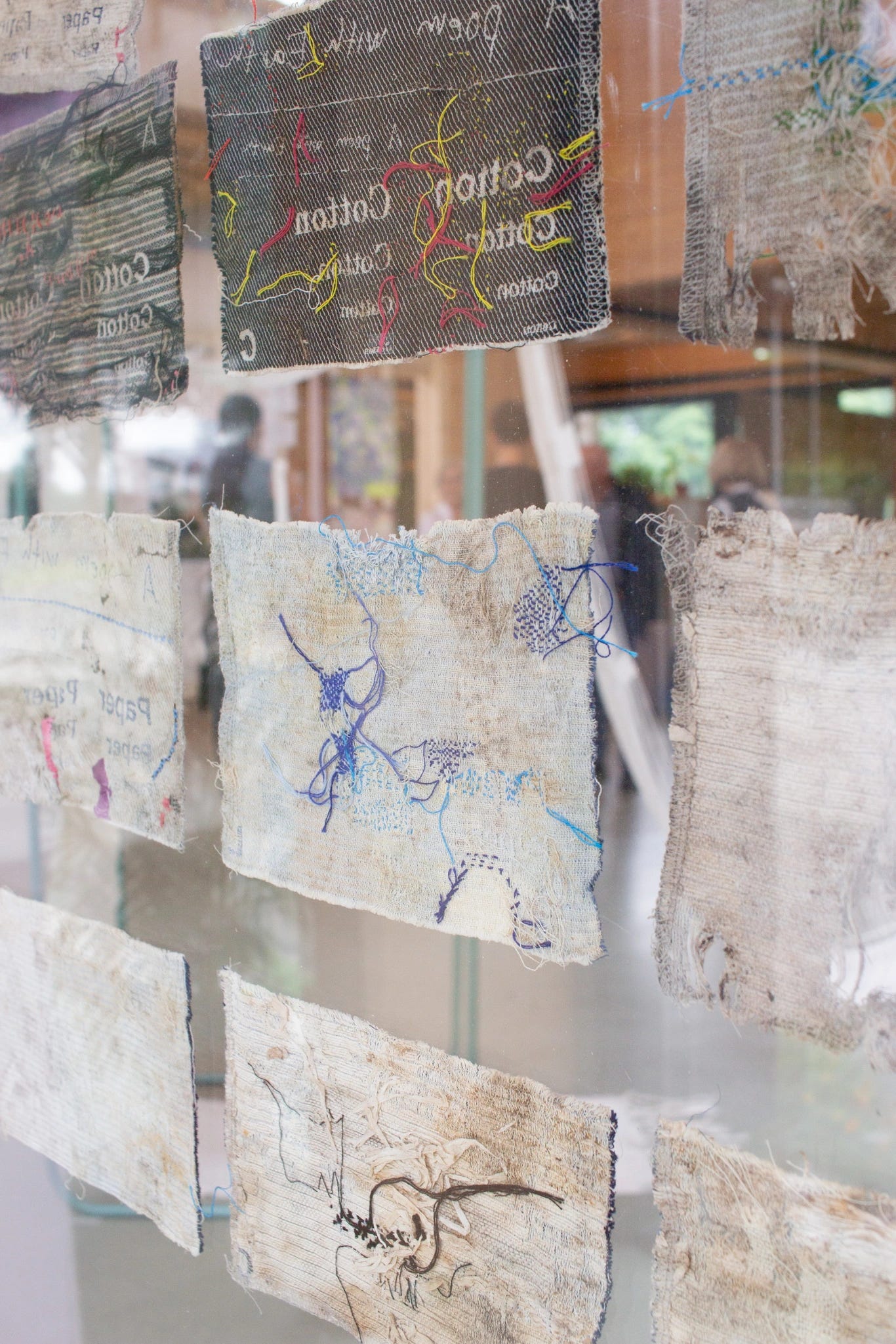
A workshop that is called ‘Landscaping in Fabric’ might just as well have been called ‘Editing with Earth’. Every text is an attempt, stands as it stands, changes with every reading. Every stitch is an attempt, stands as it stands, loosens over time or is munched on by moths. To write is to think, and to edit a patch of fabric back and forth in collaboration with the earth is to feel the same thoughts in your fingers. To revise, reinterpret, and reinvent and bury underground are ways of keeping alive or bringing alive landscape stories. Only one part of this work was shown during Van Eesteren Museum’s ‘Nieuwelingen 2025’ exhibition. The other parts are being edited in the soil of Kyoto into greater and greater abstraction.
1
for a detailed description of the history of British landscaping see The Garden Against Time by Olivia Laing.